Table of Contents
Laser welding, as a mature technology, has fundamentally transformed the landscape of manufacturing and processing industries. It utilizes a high-precision focused laser beam to melt and join materials, offering multiple advantages over traditional welding methods.
This guide will analyze the principles, techniques, and benefits of laser welding, as well as its comparison with conventional welding, helping you assess its suitability for your business needs. Please continue reading the article.
Introduction to Laser Welding Technology
Laser welding technology is an advanced manufacturing process that uses a focused laser beam to melt and join materials with high precision. Unlike traditional welding methods, which rely on heat generated from an electric arc or gas flame, welding with lasers offers exceptional control over heat distribution, making it ideal for high-precision welding applications. This process ensures clean, strong welds with minimal distortion, making it highly suitable for industries like aerospace, automotive, and electronics.
Laser welding technology is widely applicable to various materials such as metals, plastics, and ceramics, and has become the preferred solution for achieving fast, precise, and cost-effective welding.
What is laser welding?
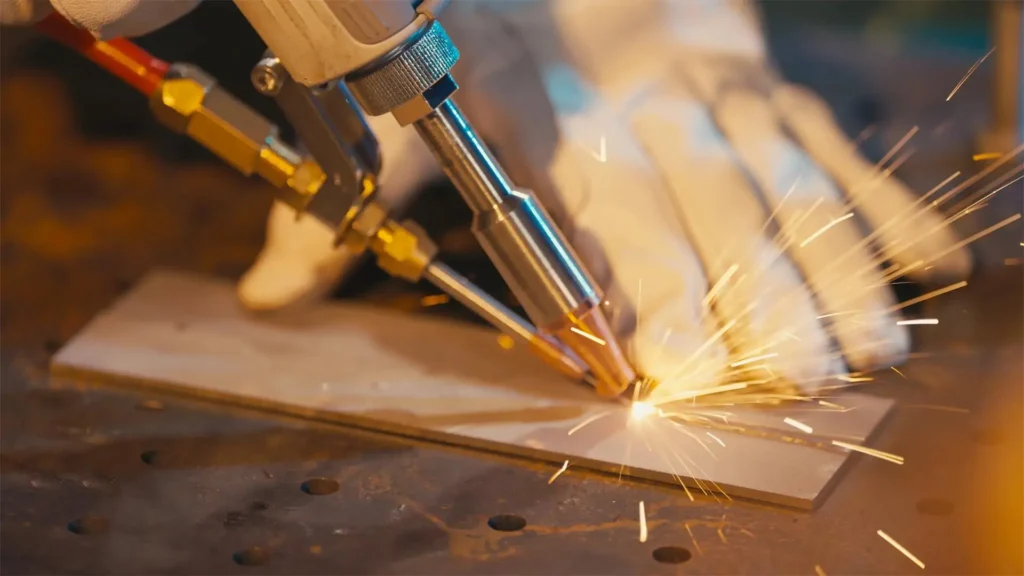
Laser welding is a high-precision joining process that uses a focused laser beam to melt and fuse materials together. The laser welding definition refers to a technique where a powerful laser is directed at the workpiece, generating enough heat to create a molten pool that solidifies to form a strong bond. Laser welding is widely used in industries requiring high accuracy, low deformation, and clean weld seams. It is also commonly compared with laser cladding in industrial surface treatment and repair applications. If you want to learn more, you can read our related article: What Is the Difference Between Laser Cladding vs Welding?
Laser welding offers high precision, producing clean, narrow welds with a minimal heat-affected zone. Unlike traditional welding methods that typically rely on electric arcs or gas flames, laser welding uses light energy to concentrate high temperatures onto a small, localized area, making it ideal for high-precision welding. Whether for thin metal sheets or precision components, laser welding provides superior speed, strength, and quality.
The history of laser welding development
The invention and initial application of laser technology (1960s): In 1960, the world’s first laser beam was successfully produced, laying the foundation for the birth of laser welding technology.
The rise of laser welding technology (1970s to 1980s): During this period, laser welding was mainly used to weld high-precision and high-demand materials and parts, such as automotive parts, aerospace components, etc.
Technological improvement and application expansion (1990s to early 21st century): In the 1990s, the development of fiber lasers and semiconductor lasers made laser welding equipment more compact and efficient, further promoting the popularization of laser welding technology. The emergence of handheld laser welding machines made laser welding more flexible and suitable for more application scenarios.
Deepening and innovation of laser welding technology (21st century to present): With the advancement of science and technology, laser welding technology continues to improve, and a variety of new lasers and welding processes have emerged. Among these, handheld lasers and robotic lasers are the most widely used. The integration of automation and intelligent technology enables laser welding to achieve high-precision and high-efficiency welding, while reducing the difficulty of operation.
Future development trend: High-power, high-precision, and high-efficiency laser welding technology will continue to develop to meet the needs of different industries. Environmental protection, energy saving, and intelligence will become the main directions for the development of laser welding technology.
The development history of laser welding technology shows its process from laboratory research to industrial application, to widespread popularization, and continuous deepening. With the continuous advancement of science and technology, laser welding technology will play an important role in more fields and become an important “hidden champion” in the manufacturing industry.
The following are reference links regarding the history of laser welding:
First operational laser built in 1960: May 16, 1960: Researcher Shines a Laser Light (first working laser) — the world’s first working laser was demonstrated using a ruby crystal in 1960.
How Does Laser Welding Work?
Laser welding works by using a high-powered laser beam to melt and fuse materials together with precision. In the laser welding process, a laser source generates a focused beam of light, which is directed onto the material’s surface. This concentrated energy melts the material, creating a molten pool that solidifies to form a strong, durable weld.
The process is highly accurate, allowing for minimal heat distortion and fine control over the weld’s size and shape. By offering speed and precision, how laser welding works makes it an ideal solution for industries requiring high-quality, strong welds in tight or complex applications.
For a deeper understanding of the welding process, including beam generation, energy transmission, and material fusion principles, read our detailed guide: How Does A Laser Welding Machine Work. This article explains the full working mechanism step by step, helping you better understand how laser power, focal control, and heat input directly affect weld quality and production efficiency.
Benefits of Laser Welding for Industrial Applications
Laser welding offers significant advantages for industrial applications, providing high efficiency, precision, and minimal thermal impact. These benefits of laser welding for industry make it a preferred choice for manufacturers seeking strong, accurate, and cost-effective welding solutions. It delivers rapid, high-quality welds with reduced heat distortion, widely used in industries such as automotive, aerospace, and electronics.
High Precision: Ensures accurate, fine welds, even in complex or tight spots.
Minimal Heat-Affected Zone: Reduces thermal distortion and damage to surrounding materials.
Fast and Efficient: Enables faster production with less downtime and lower operational costs.
Versatility: Suitable for a wide range of materials, including metals, plastics, and alloys.
Cost-Effective: Decreases material waste and reduces the need for post-processing, optimizing manufacturing costs.
Laser Welding vs. Traditional Welding Methods
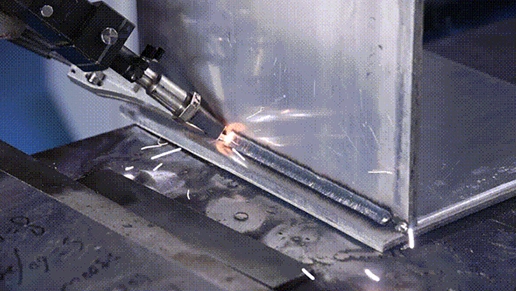
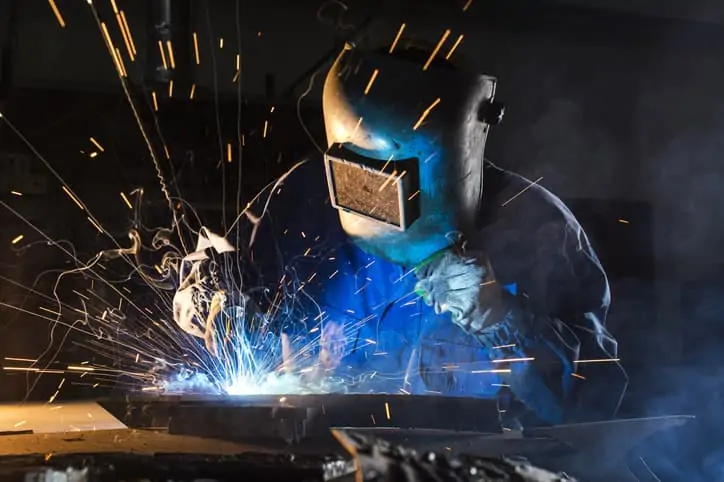
The difference between laser welding and TIG welding or laser welding and MIG welding lies in precision, speed, and heat management. Laser welding offers numerous advantages over traditional welding methods, particularly in terms of accuracy, minimal heat-affected zones, and faster processing times. It is an ideal solution for industries that require high-quality welds with minimal distortion, such as aerospace, automotive, and electronics.
Advantages of Laser Welding:
Higher Precision: Laser welding provides more accurate and cleaner welds compared to TIG and MIG welding.
Minimal Heat-Affected Zone: Reduces the risk of material distortion and thermal damage, which is common with traditional methods.
Faster Processing Time: Laser welding is significantly faster, improving overall production efficiency.
Cleaner Welds: Produces smoother, more uniform joints with less spatter, reducing the need for post-weld cleanup.
Versatility: Can weld a wide range of materials and thicknesses, ideal for intricate or thin-walled parts.
In contrast to TIG and MIG welding, which often involve larger heat zones and slower processes, laser welding’s efficiency and precision make it a top choice for high-demand manufacturing environments.
Applications of Laser Welding in Industrial Fields
Kempson’s laser welding technology, characterized by high precision, high speed, and versatility, is transforming industrial manufacturing. It enables businesses to achieve faster production cycles and superior weld quality. Key industry applications include:
Automotive Industry: Used for welding lightweight materials and thin sheet metals in vehicle bodies, delivering robust and precise welds for high-volume production.
Aerospace: Ideal for joining complex thin-walled components, delivering high-strength welds with minimal thermal distortion.
Electronics Industry: Perfect for precision micro-components like circuit boards, offering high accuracy while minimizing impact on surrounding elements.
Medical Devices: Used to manufacture small precision components requiring both accuracy and cleanliness, such as surgical instruments and implants.
Choose the Right Laser Welding Equipment
Choosing the appropriate laser welding machine can optimize production processes, enhance efficiency, and reduce costs. Therefore, factors such as equipment power, automation level, and cooling systems must be carefully evaluated before purchase. Industrial-grade laser welding equipment must align with the required material types, weld dimensions, and production scale. Key considerations for selecting a laser welding machine include:
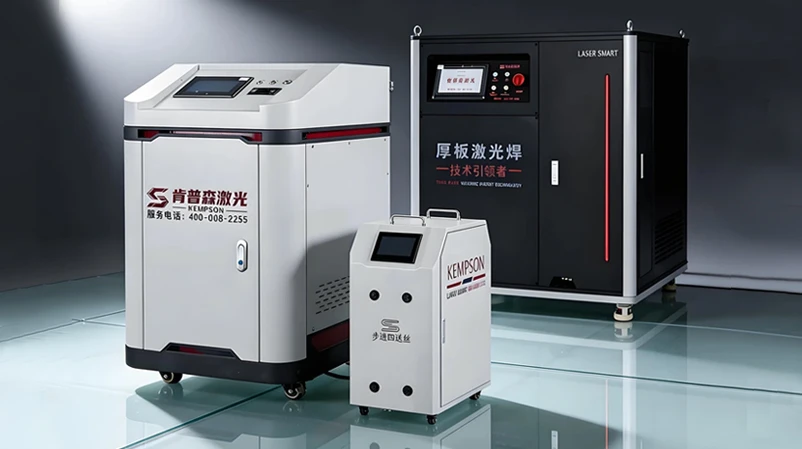
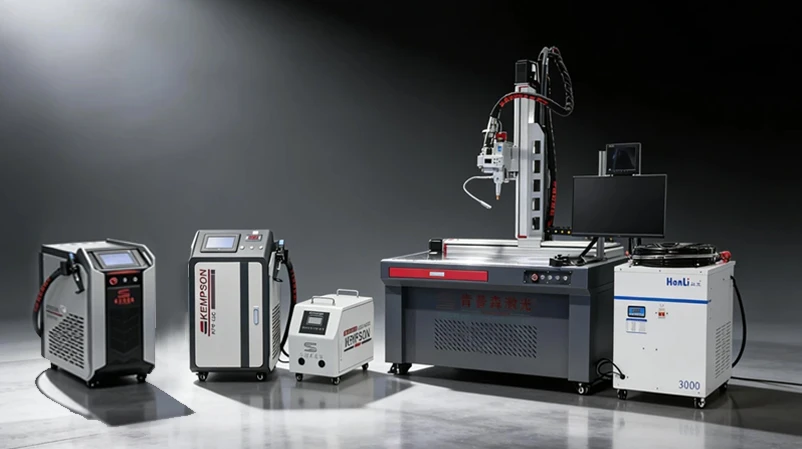
Power and Laser Type: Laser power determines the equipment’s capability to weld materials of varying thicknesses. Fiber lasers are suitable for high-speed welding, while CO₂ lasers are better suited for thicker materials.
Cooling System: A robust cooling system ensures continuous, stable operation and prevents overheating during prolonged welding, which is critical for maintaining operational efficiency.
Automation Level: Some equipment incorporates automated features like robotic arms, enhancing production efficiency and finished product consistency—particularly beneficial for high-volume manufacturing scenarios.
Precision and Focusing Capability: The laser beam’s focusing ability directly impacts weld quality and accuracy, ensuring welds meet stringent standards.
Laser Welding Process
1. Clean the parts that need to be welded and position them accurately. The joints of the components should be completely closed without any gaps.
2. Use a clamp to hold the part in place and keep it stable during the welding process.
3. Adjust the focus of the beam to the welding area.
4. Adjust the beam power and test it on some scrap materials first. Before welding the workpiece, make sure that the energy output by the beam is enough to melt the material without overheating.
5. Aim the beam at the starting point of the welding area, and after the weld is melted, move the beam smoothly along the connection. The use of traditional welding techniques such as hot spot rotation helps achieve good fusion, thereby improving weld quality.
6. After welding is complete, let the parts cool.
Laser Welding: The Future of Manufacturing
As industry continues to evolve, laser welding is emerging as a pivotal technology shaping the future of manufacturing. Its precision, speed, and ability to handle complex, high-quality welds are driving transformative change across multiple sectors, including automotive, aerospace, and electronics.
Laser welding offers advantages such as minimal thermal distortion, short production cycles, and broad material compatibility, making it increasingly popular in future manufacturing. For companies seeking to maintain competitiveness and optimize production processes, adopting laser welding technology is a wise choice to enhance efficiency, ensure quality, and reduce costs. In today’s rapidly evolving industry landscape, businesses should seize the opportunity to integrate laser welding equipment into their production processes early on, thereby boosting their competitive edge.
FAQ
What is laser welding?
Laser welding is a high-precision joining process that uses a focused laser beam to melt and fuse materials together. It concentrates high temperatures onto a small, localized area, making it ideal for thin sheets and precision components.
How does laser welding work?
Laser welding works by using a laser source to generate a focused beam of light. This concentrated energy melts the material’s surface, creating a molten pool that solidifies into a strong, durable weld with minimal heat distortion.
What are the benefits of laser welding for industrial applications?
The key benefits include high precision, a minimal heat-affected zone (HAZ), faster production speeds, versatility across materials like metals and plastics, and cost-effectiveness through reduced post-processing.
How does laser welding compare to TIG or MIG welding?
Laser welding offers higher precision, faster processing times, and significantly less material distortion compared to traditional TIG and MIG welding. It also produces cleaner, more uniform joints with less spatter.
Contact Us for Expert Laser Welding Solutions
Kempson specializes in providing advanced laser welding solutions tailored to your unique business needs. Our team of experts is ready to guide you through the process of selecting the right equipment, ensuring maximum efficiency and precision for your manufacturing operations.
Whether you’re looking to enhance your production line or explore new welding technologies, we are here to help. For more information or to request a quote, contact our team
today.