Table of Contents
Introduction
Laser welding heads are essential components in handheld laser welding systems, directly affecting welding quality, stability, and operation efficiency. During daily use, problems such as unstable laser output, damaged protective lenses, nozzle wear, and wire feeding failures may occur and reduce welding performance. Understanding common laser welding head problems and their causes helps operators quickly identify faults and take effective solutions.
In this article, I will introduce the most common laser welding head faults and troubleshooting methods, including laser output issues, lens contamination, nozzle damage, wire feeding problems, overheating, and maintenance practices. I will also share practical inspection steps and maintenance tips to help users reduce downtime laser welding equipment works reliably.

What Is a Laser Welding Head?
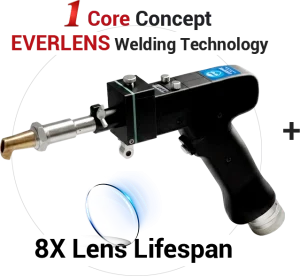
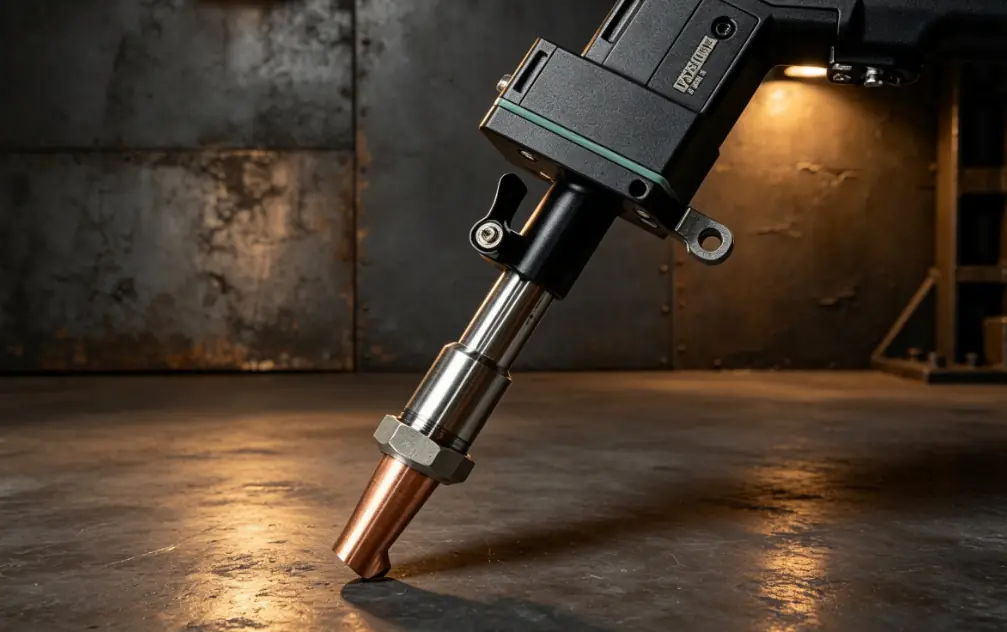
A Laser Welding Head is the working part installed at the front end of a laser welding gun. It receives the laser beam transmitted through the fiber cable, focuses the beam onto the workpiece, and completes the welding process. The welding head combines optical lenses, a protective lens, a copper nozzle, a wire feeding channel, and cooling components.
The focusing lens inside the welding head concentrates the laser beam into a small welding area, with a spot diameter of 0.2–0.6 mm. The nozzle delivers shielding gas to protect the molten pool, the wire feeding channel supplies filler wire when required, and the cooling system controls the heat generated during long-time operation.

Common Laser Welding Head Problems and Solutions
Laser welding head is a key component of the welding system. Its condition affects laser transmission, weld formation, and operation stability. Common failures include protective lens contamination, focus deviation, wire feeding problems, shielding gas issues, and cooling system faults.
Focus Deviation
- Problem: The focusing lens generates heat during high-power welding. Temperature changes can shift the focal position, causing unstable penetration or uneven weld seams. A focus deviation above 0.2 mm may affect welding quality.
- Solution: Check the cooling performance of the lens assembly and calibrate the focus position when welding quality changes. Maintain stable temperature conditions during continuous operation.
Protective Lens Contamination
- Problem: Welding spatter, smoke, and metal particles attach to the protective lens during operation. A contaminated lens reduces laser transmission and affects welding penetration.
- Solution: Clean the protective lens regularly and replace damaged lenses in time. Use proper shielding gas protection, with argon flow commonly set at 20–25 L/min, to reduce contamination.
View applications and product details for protective lenses: Laser Welder Protective Lens & Focus Lens (5+1 Pieces) for Handheld Laser Welding Machine
Wire Feeding Problems
- Problem: Unstable wire feeding causes uneven weld filling, inconsistent weld width, and poor weld appearance. The main causes include incorrect wire pressure, worn feeding rollers, and blocked wire paths.
- Solution: Check the wire feeder, feeding rollers, and wire guide tube. Adjust wire feeding speed according to laser power, welding speed, and material requirements.
View details on wire feeders, wire feeding speed, and power settings: Laser Welding Wire Feeder, Laser Welding Wire Feeding Speed: How to Set the Right Parameters
Shielding Gas Flow Problems
- Problem: Insufficient shielding gas flow causes oxidation and porosity in the weld area. Excessive gas flow creates turbulence and affects molten pool stability.
- Solution: Adjust gas flow and nozzle position according to the welding process. Maintain stable argon flow, normally around 20–25 L/min, to protect the welding area.
To achieve better weld quality, protective gas is often used during welding. Read more about gas classifications and applications: Argon vs. Nitrogen for Laser Welding: Which Gas Should You Use?
Oscillation System Failure
- Problem: The oscillation mechanism controls the movement of the laser beam. A faulty system causes irregular weld patterns and unstable heat distribution, especially in aluminum welding and gap filling applications.
- Solution: Check the oscillation motor, control system, and welding parameters. Adjust oscillation width and frequency based on material thickness and welding speed.
Cooling System Failure
- Problem: Insufficient cooling increases the temperature of optical and mechanical parts. Long-term operation under high temperature conditions causes focus changes and component wear, especially for laser powers above 3 kW.
- Solution: Check the coolant temperature and water flow before operation. Keep the cooling system running at 20–25°C to prevent overheating during welding.
Laser welding head failures mainly occur in optical parts, consumable components, wire feeding systems, and cooling units. Regular inspection and correct parameter adjustment reduce equipment downtime and maintain stable welding performance.
Laser Welding Head Troubleshooting Checklist
Laser welding head faults are mainly related to optical components, mechanical parts, gas supply, wire feeding, and cooling systems. The following checklist lists common problems, possible causes, and troubleshooting methods for quick inspection.
| Problem | Possible Cause | Check & Solution |
|---|---|---|
| Low laser power or unstable welding | Protective lens contamination, lens damage, optical path contamination | Check the protective lens for dust, spatter, or burn marks. Clean the lens or replace it if damaged. |
| Uneven weld seam or poor penetration | Focus deviation, incorrect laser alignment, improper welding parameters | Check the laser spot position and adjust the focus. Keep the focus accuracy within ±0.05 mm. |
| Welding head nozzle damage | Collision, high temperature, long-term wear | Check the nozzle condition. Replace the nozzle if deformation, wear, or cracks appear. |
| Black weld surface or excessive smoke | Insufficient shielding gas, incorrect gas direction, blocked nozzle | Check gas pressure and nozzle condition. Adjust shielding gas flow, usually 8–15 L/min for stable protection. |
| Uneven wire feeding or inconsistent weld width | Wire feeder failure, worn feeding rollers, incorrect wire pressure | Check the wire feeder, feeding rollers, and wire path. Adjust wire speed and feeding pressure according to welding conditions. |
| Welding head overheating | Cooling system failure, insufficient coolant flow, high working temperature | Check coolant temperature, water level, and circulation. Keep coolant temperature around 20–25°C during operation. |
| No laser output | Laser source alarm, cable connection problem, damaged optical components | Check laser source status, power connection, and internal optical parts. Replace damaged components when necessary. |
| Laser power decrease during operation | Aging laser source, contaminated lens, poor cooling performance | Check laser output power and optical components. Inspect the cooling system if power drops during continuous welding. |
| Frequent welding head alarms | Loose connections, sensor errors, unstable working environment | Check electrical connections, sensors, and operating conditions. Keep the working environment around 15–30°C. |
Regularly check the laser welding head components and solve problems in time to avoid welding defects and unnecessary equipment downtime.
How to Prevent Laser Welding Head Problems?
- Clean the Protective Lens Regularly — Check the protective lens before and after welding. Remove dust and spatter in time to prevent laser power loss and welding defects.
- Replace Consumable Parts on Time — Inspect nozzles, protective lenses, and other wear parts regularly. Replace damaged components to avoid unstable welding performance.
- Maintain the Cooling System — Check coolant temperature, water level, and flow condition regularly. Keep the cooling system working normally during continuous welding.
- Check Wire Feeding System — Keep the wire path clean and check feeding rollers, wire pressure, and feeding speed to prevent unstable wire supply.
- Use Correct Welding Parameters — Set proper laser power, welding speed, focus position, and wire feeding speed according to material thickness and welding requirements.
- Keep the Working Area Clean — Reduce dust, metal particles, and welding spatter around the equipment to protect optical components and internal parts.
- Perform Regular Equipment Inspection — Check connections, sensors, and mechanical parts regularly to find loose or damaged components before operational problems occur.
When Should You Replace a Laser Welding Head?
1. Unstable Laser Output: Replace the welding head when laser output remains unstable after cleaning and adjustment.
2. Poor Welding Quality: Replacement is required when weld defects such as poor penetration, uneven seams, or excessive spatter cannot be solved through parameter adjustment.
3. Optical Components Are Damaged: Replace the welding head if the internal lens system or key optical parts are damaged and cannot be repaired.
4. Frequent Equipment Failures: Repeated alarms, signal errors, or unstable operation indicate the welding head may need replacement.
5. High Maintenance Cost: Replace the welding head when repair costs and downtime exceed the value of continued maintenance.
Conclusion
Laser welding head performance directly affects welding quality and equipment operation. Problems such as lens contamination, nozzle wear, wire feeding failure, and cooling issues should be checked and handled in time to avoid welding defects and production downtime.
KEMPSON provides reliable laser welding solutions and welding head accessories for different industrial applications. If you need technical support, equipment selection, or replacement parts, contact us for professional assistance.
FAQ
What are the common problems with a laser welding head?
Common problems include protective lens contamination, nozzle damage, unstable wire feeding, focus deviation, cooling failure, and unstable laser output.
Why is my laser welding head not producing stable welds?
Unstable weld quality is usually caused by dirty lenses, incorrect focus position, improper welding parameters, or unstable wire feeding.
How often should I clean the laser welding head lens?
The protective lens should be checked regularly and cleaned whenever dust, smoke, or welding spatter appears on the surface.
What causes a laser welding head to overheat?
Overheating is mainly caused by insufficient coolant flow, abnormal water circulation, or continuous operation under high laser power.
Why does the laser welding head nozzle need to be replaced?
The nozzle may deform or wear after long-term use or collision, which affects shielding gas flow and weld quality.
How can I troubleshoot a laser welding head with low laser power?
Check the protective lens, optical components, laser source status, and cooling system to find the cause of power loss.
How long does a laser welding head last?
The service life depends on laser power, working environment, operation frequency, and maintenance condition.
Can a damaged laser welding head be repaired?
Some parts, such as protective lenses, nozzles, and wire feeding components, can be replaced. A damaged internal optical system may require welding head replacement.