Table of Contents
Introduction
Laser cleaning is becoming an alternative solution to traditional surface treatment methods such as sandblasting and chemical cleaning due to its non-contact process, lower material damage risk, and cleaner operation. However, different materials, contaminants, and production requirements require different laser cleaning solutions. The main difference between pulsed and continuous laser cleaning machines is how they deliver laser energy. Pulsed laser cleaning releases high peak energy in short pulses, while continuous laser cleaning provides stable continuous laser output for large-area and heavy-duty cleaning. These two technologies are not direct replacements for each other but are designed for different application requirements.
This article compares pulsed laser cleaning machines and continuous laser cleaning machines in terms of working principles, cleaning performance, application scenarios, and selection factors. By understanding the differences between the two technologies, you can choose the right laser cleaning equipment based on material characteristics, contamination type, cleaning area, and production needs.
For more detailed information on laser cleaning machines, read the article: “What Is a Laser Cleaning Machine? Working Principle, Types, Applications & Buying Guide”
What Is a Pulsed Laser Cleaning Machine?
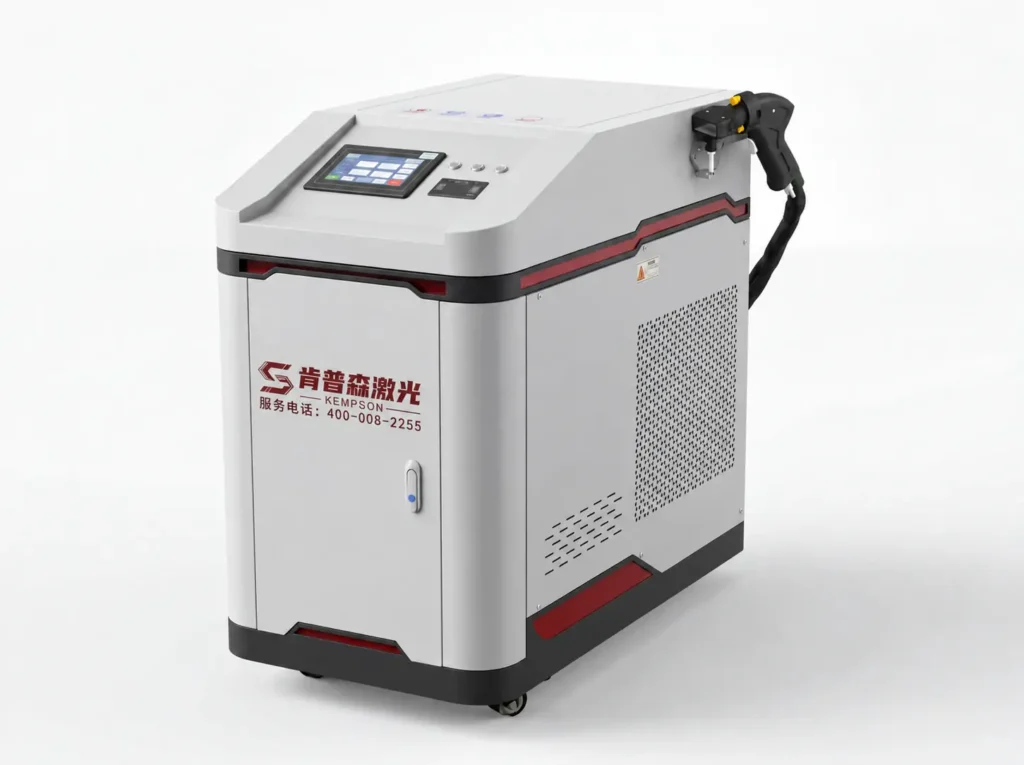
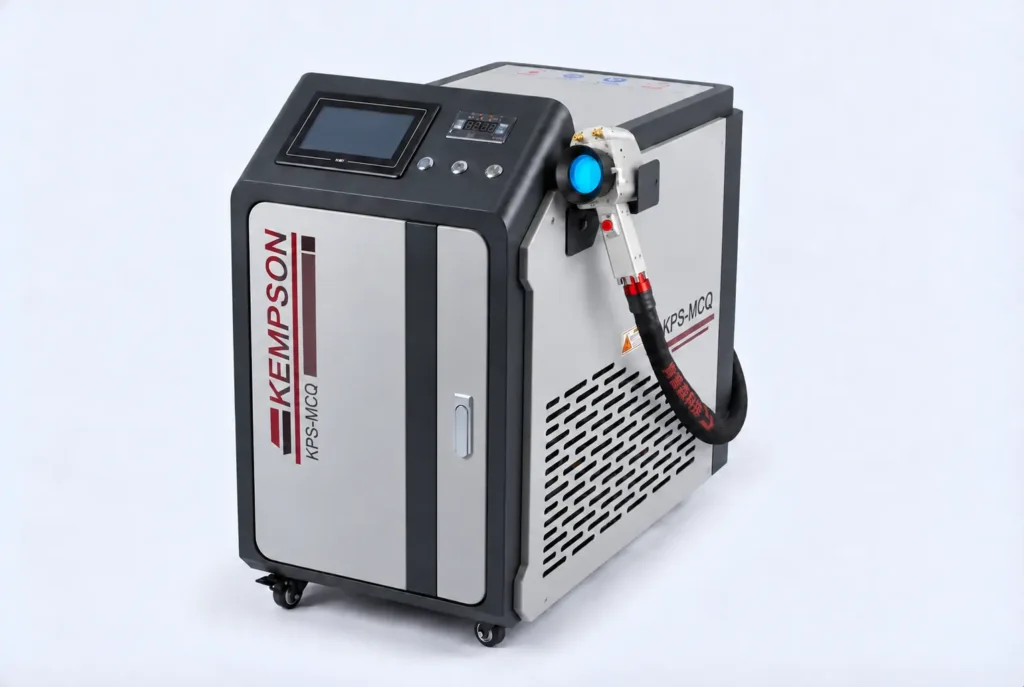
A pulsed laser cleaning machine uses a MOPA pulsed fiber laser to remove rust, oxide layers, paint, and other surface contaminants through short-duration laser pulses. Unlike continuous laser cleaning, pulsed laser cleaning delivers high peak energy in a controlled pulse width, reducing heat accumulation on the substrate and making it suitable for applications requiring precise surface treatment.
KEMPSON KPS-MCQX series pulsed laser cleaning machines use MOPA pulsed fiber laser technology, with adjustable laser parameters such as power, frequency, and pulse width to match different materials, contamination conditions, and cleaning requirements. The system can be configured with different pulse energy, scanning lenses, and cooling solutions according to specific applications.
How Does Pulsed Laser Cleaning Work?
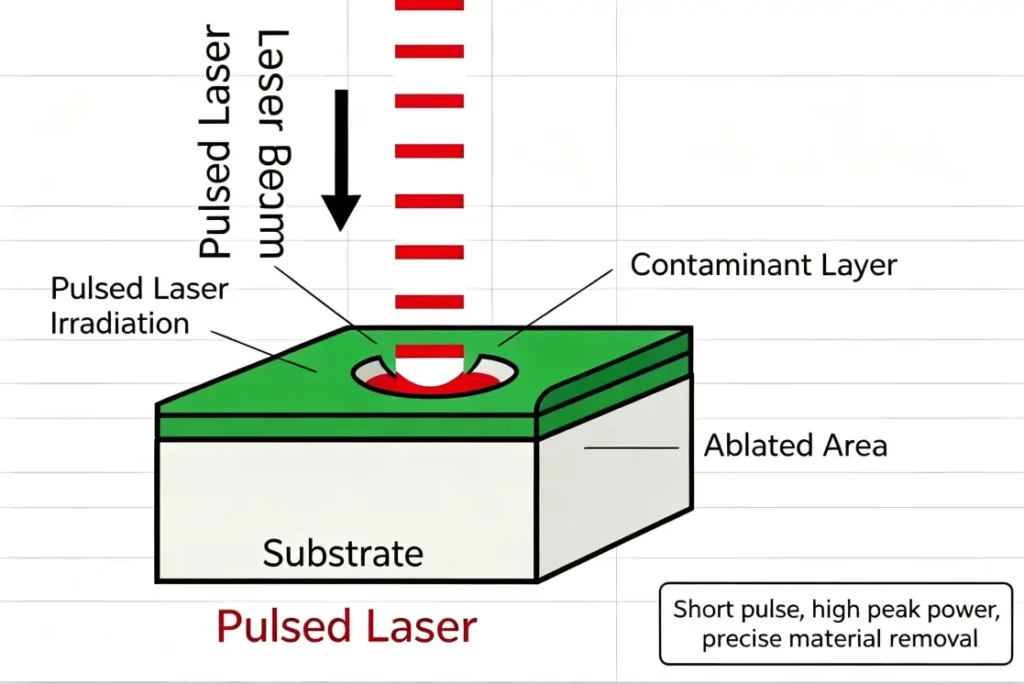
Pulsed laser cleaning removes surface contaminants through controlled laser energy interaction. During operation, the laser beam rapidly scans across the workpiece surface, causing rust, oxide layers, or approved coating materials to separate, break down, or vaporize while minimizing effects on the base material. The generated particles and fumes are removed through an extraction system.
Cleaning process:
- Laser pulse reaches the contaminated surface
Short laser pulses are focused onto the surface layer, delivering concentrated energy to the target area. - Energy breaks the bond between contaminants and substrate
The absorbed laser energy causes thermal expansion, separation, or material breakdown of rust, oxides, and coatings. - The contaminant layer is removed
Surface contaminants are detached from the substrate through peeling, fragmentation, or vaporization. - Particles are collected by the extraction system
The removed particles and smoke are captured to maintain a cleaner working environment.
Pulsed laser cleaning is widely used where surface precision and controlled heat input are important, especially for components that require protection of the base material during cleaning.
What Is a Continuous Laser Cleaning Machine?
A continuous laser cleaning machine uses continuous-wave laser output to provide stable and consistent energy input for surface treatment. Compared with pulsed laser cleaning, continuous laser cleaning delivers higher average power, making it suitable for removing heavy rust, thick oxide layers, and large-area surface contaminants where cleaning efficiency is a priority.
KEMPSON KPS-QX3000 and KPS-QX4000 continuous laser cleaning machines use continuous fiber lasers with 3000W and 4000W laser output. The system is designed for metal surface cleaning, rust removal, and pre-welding surface preparation with a handheld laser cleaning head and water cooling system.
How Does Continuous Laser Cleaning Work?
Continuous laser cleaning uses a continuous laser beam to deliver stable heat energy to the surface. The laser interacts with rust, oxidation, and other contaminants, weakening their bonding with the substrate and removing unwanted layers through controlled thermal effects.
Cleaning process:
- The continuous laser beam heats the surface layer
The laser continuously transfers energy to the contaminated area, creating a stable thermal effect. - Contaminants are separated from the substrate
The heat input breaks the adhesion between rust, oxides, and surface contaminants, allowing them to be removed. - Large-area cleaning is completed with higher efficiency
Continuous laser output provides higher average power, making it suitable for large metal surfaces and heavy-duty cleaning applications. - Dust and particles are removed through the protection system
The cleaning head uses an air knife structure to reduce dust and particles entering the optical components.
For details on the working principles and process of precision laser cleaning and rust removal, see: How Does a Laser Cleaning Machine Work?
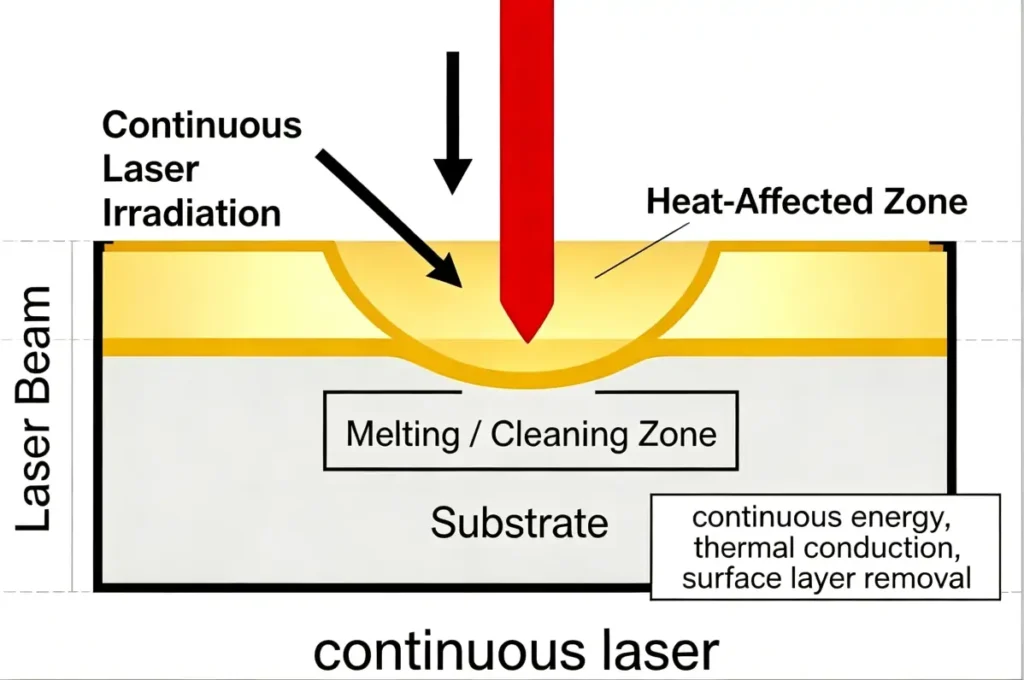
Continuous laser cleaning machines are commonly used in applications requiring high cleaning efficiency, including shipbuilding and maintenance, steel structures, heavy machinery, railway equipment, and welding surface preparation. KEMPSON KPS-QX3000 and QX4000 models provide adjustable cleaning widths of 5–30 cm and cleaning speeds of 0.4–1.5 m²/min, depending on the model and process conditions.
Pulsed Laser Cleaning Machine vs Continuous Laser Cleaning Machine: Key Differences
Pulsed laser cleaning machines and continuous laser cleaning machines use different laser output methods, which directly affect cleaning performance, heat input, efficiency, and application range. Pulsed laser cleaning focuses on precise energy control and lower thermal impact, while continuous laser cleaning provides higher average power for large-area and heavy-duty surface treatment.
| Comparison Item | Pulsed Laser Cleaning Machine | Continuous Laser Cleaning Machine |
|---|---|---|
| Laser source | MOPA pulsed fiber laser | Continuous-wave fiber laser |
| Laser output mode | Short laser pulses | Continuous laser beam |
| Energy delivery | High peak energy in a short duration | Stable continuous energy output |
| Heat input | Lower heat accumulation, better thermal control | Higher continuous heat input for efficient material removal |
| Cleaning precision | Suitable for precise surface cleaning | Suitable for large-area cleaning |
| Cleaning efficiency | Suitable for small to medium areas and detailed processing | Higher efficiency for large surfaces and heavy contamination |
| Typical applications | Precision parts, molds, sensitive components, coating removal | Shipbuilding, steel structures, heavy machinery, railway equipment |
| Common power range | 300W / 500W / 1000W configurations | 3000W / 4000W configurations |
| Main advantage | Controlled energy input and substrate protection | High cleaning speed and strong rust removal capability |
- Pulsed laser cleaning machines: Use MOPA pulsed fiber laser technology with adjustable power, frequency, and pulse width for precision cleaning and applications requiring lower heat impact.
- Continuous laser cleaning machines: Provide 3000W–4000W continuous laser output for large-area surface cleaning, rust removal, and high-efficiency industrial applications.
The right laser cleaning machine depends on the material, contamination condition, cleaning area, and production requirements.
Difference in Cleaning Performance
Pulsed laser cleaning and continuous laser cleaning have different performance characteristics. Pulsed laser cleaning focuses on precise energy control and low heat input. Continuous laser cleaning uses higher average power for large-area surface treatment and high-efficiency cleaning.
Pulsed Laser Cleaning Precision
Pulsed laser cleaning is suitable for applications where surface damage control and cleaning accuracy are required. Short laser pulses deliver concentrated energy to the contamination layer and limit heat transfer to the base material.
Features:
- Suitable for delicate surfaces
- Effective for thin coatings and oxide layers
- Suitable for heat-sensitive materials
- Controlled heat-affected area
Applications: Molds, Precision parts, electronic components
Continuous Laser Cleaning Speed
Continuous laser cleaning uses continuous laser output with higher average power. It is suitable for large metal surfaces, heavy rust removal, and industrial cleaning processes with high output requirements.
Features:
- Higher average power
- Larger cleaning width
- Higher cleaning efficiency on large surfaces
The cleaning speed and actual efficiency vary with material type, rust condition, cleaning width, and process parameters.
Pulsed laser cleaning is used for precision surface treatment and applications requiring controlled heat input. Continuous laser cleaning is used for large-area cleaning and heavy-duty rust removal.
Pulsed vs Continuous Laser Cleaning Applications
Pulsed laser cleaning and continuous laser cleaning are used for different industrial applications. The selection depends on material characteristics, contamination type, cleaning area, and production requirements.
Applications for Pulsed Laser Cleaning Machines
Precision parts
Used for small components requiring accurate cleaning and protection of the base material.
Mold cleaning
Removes rust, release agents, and surface residues from molds without abrasive contact.
Automotive components
Cleans automotive parts such as metal surfaces before coating, bonding, or assembly.
Surface preparation
Provides controlled surface treatment before welding, coating, and other manufacturing processes.
Rust removal on sensitive materials
Removes oxidation and rust from materials with strict heat input requirements.
Electronic components
Cleans sensitive metal surfaces and removes contaminants where low thermal impact is required.
Applications for Continuous Laser Cleaning Machines
Large metal surfaces
Provides high-efficiency cleaning for large workpieces and metal structures.
Welding preparation
Removes rust, oil, and contaminants before welding to improve surface conditions.
Industrial equipment maintenance
Used for regular cleaning and surface treatment of large-scale production equipment.
Ship maintenance
Used for removing rust, coatings, and surface contaminants during ship repair and maintenance.
Steel structures
Cleans large steel structures by removing rust, oxide layers, and old surface coatings.
Heavy machinery
Suitable for equipment maintenance, rust removal, and surface restoration of industrial machines.
Not all materials are suitable for laser cleaning. To learn about compatible materials and detailed applications, read the article: “What Materials Can Be Laser Cleaned? A Complete Guide to Laser Cleaning Materials”
How to Choose Between Pulsed and Continuous Laser Cleaning Machines?
Choosing between a pulsed laser cleaning machine and a continuous laser cleaning machine depends on the material, contamination condition, cleaning accuracy, workpiece size, and production requirements.
1. Consider Material Type
The substrate material directly affects laser selection. Materials with high sensitivity to heat require better control of energy input, while thick metal structures usually require higher cleaning power.
1. Is the substrate sensitive to heat?
2. Is the surface thin or thick?
3. Does the material require protection from thermal effects?
Selection guide:
- Thin or heat-sensitive materials → Pulsed laser cleaning machine
Suitable for components requiring controlled heat input and surface protection. - Heavy steel structures → Continuous laser cleaning machine
Suitable for thick metal surfaces, heavy rust, and large-area cleaning.
2. Consider Cleaning Requirements
The cleaning target determines the required laser output mode.
- Precision cleaning → Pulsed laser cleaning machine
Suitable for removing thin coatings, oxide layers, and contaminants from precision components. - Large-area rust removal → Continuous laser cleaning machine
Suitable for removing heavy rust and surface contaminants from large metal structures with higher cleaning efficiency.
3. Consider Production Efficiency
Production volume and processing requirements affect equipment selection.
- Small batch production or precision processing → Pulsed laser cleaning machine
Suitable for detailed cleaning tasks where surface quality and process control are important. - Continuous production → Continuous laser cleaning machine
Suitable for industrial cleaning operations requiring higher throughput and stable operation.
4. Consider Contamination Type and Thickness
Different contaminants require different energy levels.
- Light rust, oxide film, oil residue, and thin coatings → Pulsed laser cleaning
Provides controlled energy delivery for surface-sensitive cleaning. - Heavy rust, thick oxide layers, and old coatings → Continuous laser cleaning
Provides higher power output for stronger cleaning capability.
5. Consider Workpiece Size and Cleaning Area
The size of the workpiece affects cleaning efficiency.
- Small components and complex surfaces → Pulsed laser cleaning
Suitable for detailed areas, precision parts, and localized cleaning. - Large structures and wide surfaces → Continuous laser cleaning
Suitable for large metal surfaces, steel structures, ship components, and industrial equipment.
The right laser cleaning machine should match the material condition, cleaning target, and production process rather than only the laser power. Pulsed and continuous laser cleaning technologies serve different industrial requirements.
Pulsed Laser Cleaning Machine or Continuous Laser Cleaning Machine: Which One Is Better?
Neither pulsed laser cleaning nor continuous laser cleaning is universally better. The suitable choice depends on the material type, contamination condition, cleaning area, and production requirements.
- Pulsed laser cleaning machines are suitable for precision cleaning applications where controlled heat input, surface protection, and cleaning accuracy are required.
- Continuous laser cleaning machines are suitable for large-area cleaning, heavy rust removal, and industrial applications requiring higher cleaning efficiency.
Selecting the right laser cleaning machine requires evaluating the workpiece condition, cleaning target, and operating environment to match the appropriate laser technology.
KEMPSON Laser Cleaning Solutions
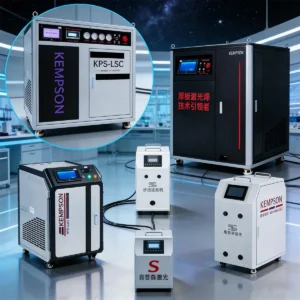
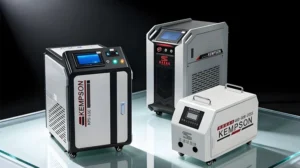
KEMPSON provides pulsed and continuous laser cleaning solutions for different surface treatment requirements. The product selection covers precision cleaning, rust removal, coating removal, and large-area industrial cleaning applications.
Pulsed Laser Cleaning Solution: KPS-MCQX Series
KPS-MCQX series uses MOPA pulsed fiber laser technology for precision surface cleaning. The laser parameters, including power, frequency, and pulse width, can be adjusted according to different materials and cleaning requirements.
Features:
- MOPA pulsed fiber laser
Provides adjustable pulse control for different surface conditions. - 300W / 500W / 1000W configurations
Available in multiple power options with customized configurations. - Adjustable pulse parameters
Allows control of cleaning energy based on material characteristics and contamination conditions. - Handheld dual-axis cleaning system
Supports flexible operation for different workpieces and cleaning areas.
Continuous Laser Cleaning Solution: KPS-QX3000 / QX4000
KPS-QX3000 and QX4000 are continuous laser cleaning machines designed for metal surface cleaning, rust removal, and welding surface preparation. The systems use continuous fiber lasers with 3000W and 4000W output.
Features:
- 3000W / 4000W continuous laser output
Provides stable laser energy for large-area and heavy-duty cleaning applications. - Handheld laser cleaning head
The LSQ-60Q cleaning head connects through a QBH interface and uses an F1000 focusing lens. - Water cooling system
Maintains stable operation of the laser source and cleaning components. - Gas knife protection
The cleaning head uses an air knife structure to reduce dust and particles entering the optical components.
KEMPSON laser cleaning solutions cover different application requirements, from precision cleaning with pulsed laser technology to high-efficiency industrial cleaning with continuous laser technology.
Conclusion
Pulsed laser cleaning and continuous laser cleaning serve different industrial cleaning requirements. Pulsed laser cleaning focuses on precision processing and controlled heat input, making it suitable for applications requiring surface protection. Continuous laser cleaning focuses on higher laser power and cleaning efficiency for large-area surfaces and heavy-duty applications.
The right laser cleaning machine depends on the material type, contamination condition, workpiece size, and production requirements. KEMPSON provides customized pulsed and continuous laser cleaning machines with 300W–4000W configurations to match different surface treatment applications. Contact our team for a suitable laser cleaning solution based on your cleaning requirements.
FAQ
What is the difference between pulsed and continuous laser cleaning machines?
Pulsed laser cleaning uses short, high-energy laser pulses for precise surface treatment, while continuous laser cleaning uses stable laser output for faster cleaning of larger metal surfaces.
Is pulsed laser cleaning better than continuous laser cleaning?
Neither technology is suitable for all applications. Pulsed laser cleaning is preferred for precision cleaning, while continuous laser cleaning is commonly used for heavy rust removal and large-area surface treatment.
Which laser cleaning machine is better for rust removal?
Continuous laser cleaning machines are suitable for thick rust and large steel surfaces because they provide higher continuous power. Pulsed laser cleaning works better when substrate protection and precision are important.
Can pulsed laser cleaners remove paint and coatings?
Yes. Pulsed laser cleaners can remove rust, oxide layers, and certain coatings by controlling pulse energy, frequency, and scanning parameters.
What laser power is needed for industrial laser cleaning?
The required power depends on material, contamination thickness, and cleaning speed. Pulsed machines commonly use hundreds of watts, while continuous machines often use several kilowatts for heavy-duty applications.
Is continuous laser cleaning faster than pulsed laser cleaning?
Continuous laser cleaning usually provides higher cleaning speed on large surfaces because of higher average power output.
Can one laser cleaning machine handle all applications?
No. Different materials and contamination types require different laser parameters and machine configurations.
How do I choose a laser cleaning machine supplier?
Choose a supplier that can provide application testing, customized configurations, technical support, and after-sales service for your specific cleaning requirements.